
Road noteIn the centre of Bikaner, about 250 km from Jodhpur by a long straight desert road. Parking near the gate is limited. Midday heat is fierce outside winter.
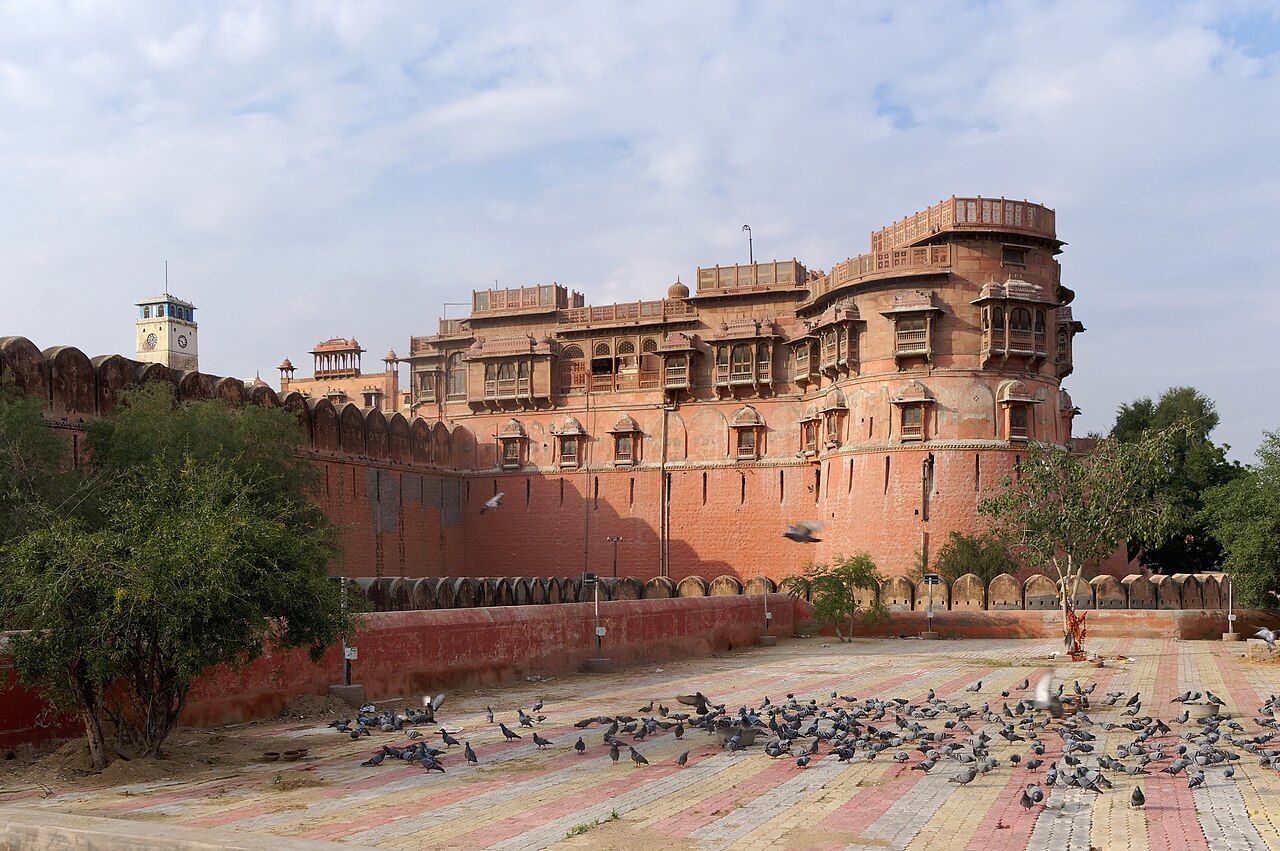
Most of Rajasthan's great forts climb. They sit on ridges and crags, and you see them from far off before you reach them. Junagarh is different. It stands on the flat ground of the Thar plain in the middle of Bikaner, its long red sandstone walls rising straight from the city streets, with a moat line and a deep belt of wall instead of a cliff. You do not look up at it from miles away. You come round a corner and it is there.
It is still one of the strongest-looking buildings in the state. And behind those walls is something no one expects from the outside: a series of palace rooms covered in gold leaf, mirror work, lacquer and paint, some of the richest interiors in Rajasthan.
A fort built on the plain
The fort was built between 1589 and 1594 under Raja Rai Singh, ruler of Bikaner and a general in the service of the Mughal emperor Akbar. That connection shaped both its wealth and its style. Rai Singh had seen the courts of the Mughals, and the palaces he and his successors built inside the walls borrow freely from them while keeping the Rajput habit of high, defended walls and narrow approaches.
Without a hill to rely on, the defence was all in the building: a perimeter wall with many bastions, a moat, and a series of gates, each set at an angle so that no one could charge straight through. It is commonly said that the fort was never taken by force, despite attempts. Whatever the full history, the walls still look as if they mean it.
The stone is the warm red sandstone of the region, and in late afternoon the walls go almost orange. Above the battlements, the palace buildings climb in balconies, jharokhas and small domed pavilions, each storey a little lighter than the one below.
Through the gates and into the courtyards
You enter through a sequence of gates, the main one on the east side. Look for the handprints carved near one of them: they are memorials to royal women who died by sati, a reminder that the beauty of these places sits on a hard history. Beyond the gates the fort opens into a run of courtyards, broad and sunlit, with the palace fronts rising around them.
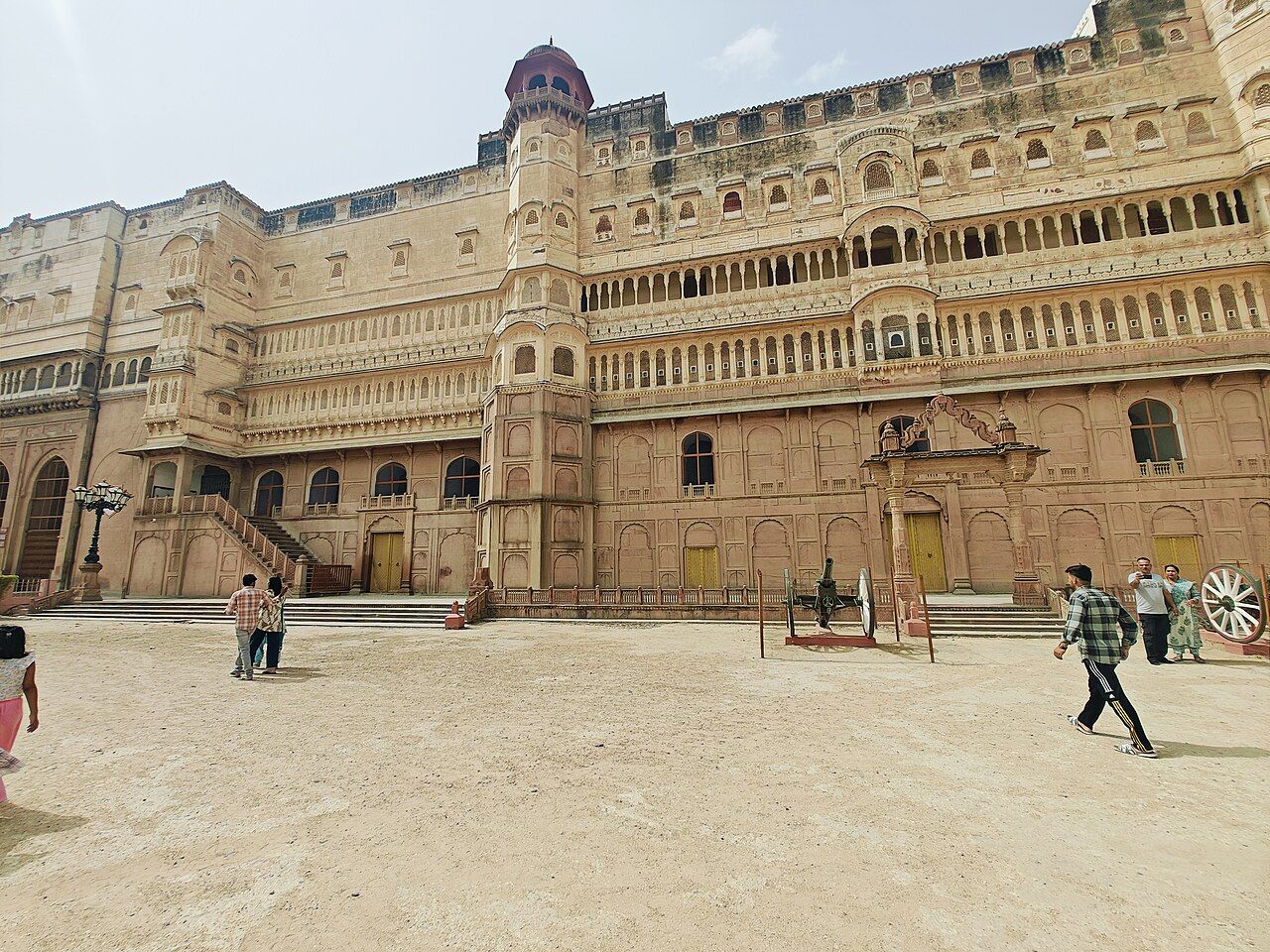
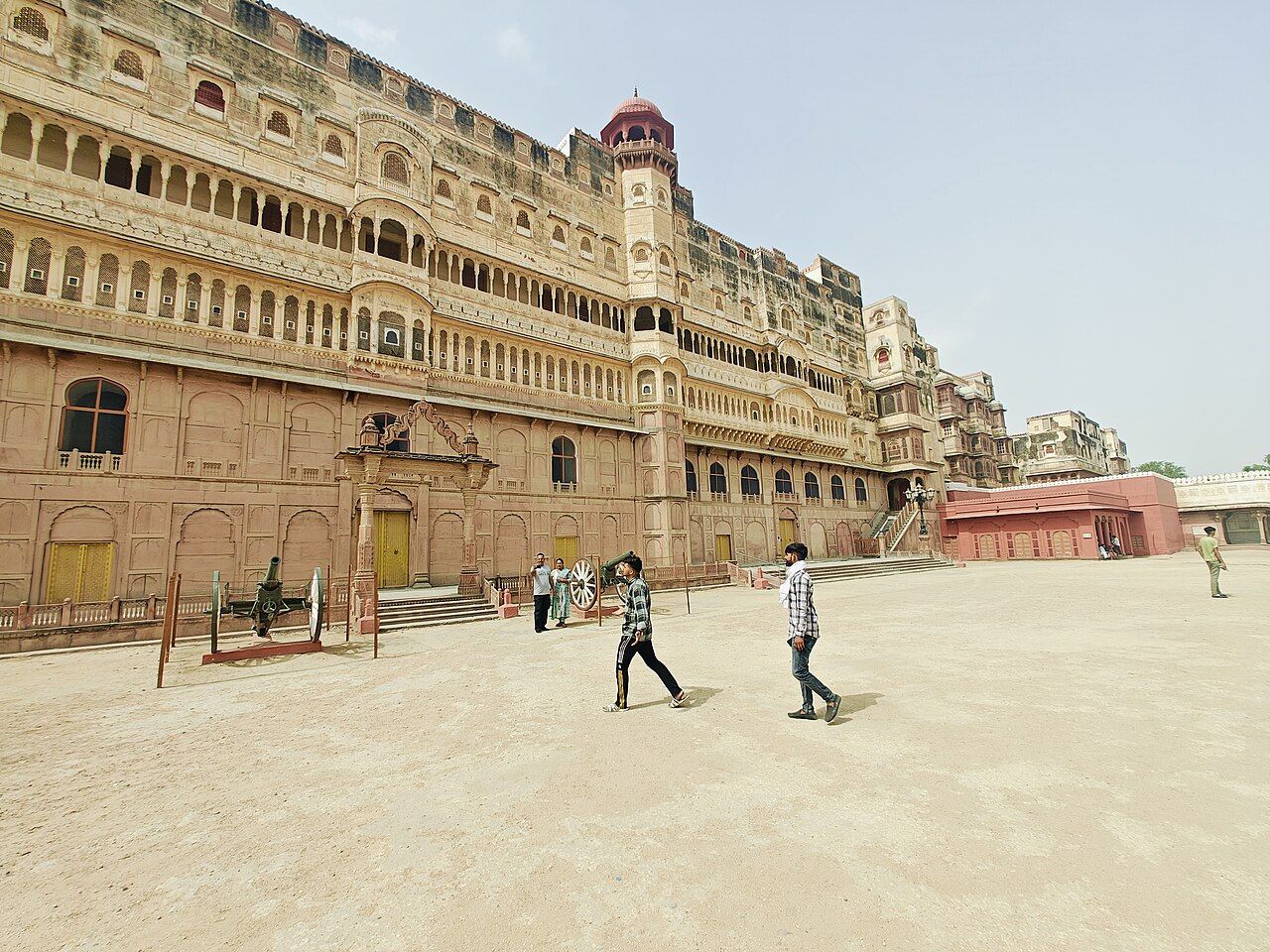
The courtyards are where you see how the fort grew. Successive rulers added palaces over about three centuries, each in the taste of its day, so the facades change as you move: older work in plainer sandstone, later wings in pale stone with rows of latticed windows, some pieces with a touch of European influence from the 19th and early 20th centuries. Cannon and old carriages stand along the walls.
The painted and gilded rooms
Most of the fort's palace rooms are now a museum, and a set route takes you through them. The route changes from time to time, and some rooms may be closed, but the core of it is a walk through the private and ceremonial spaces of the Bikaner court.
Anup Mahal
Anup Mahal is the room most people remember. Its walls and ceilings are worked in red and gold, with gilt and lacquer patterns covering almost every surface, and the effect in the half-light is closer to the inside of a jewel box than to a hall. It was used for ceremonies of the court, and it still feels formal and slightly overwhelming.
Phool Mahal and Karan Mahal
Phool Mahal, the "flower palace", is among the older parts of the palace, with mirror work and painted flowers set into the walls. Karan Mahal, a hall built for gatherings of the court, is another layer of gilt, colour and carved stone. Between them run corridors and small chambers painted with patterns and scenes, windows of coloured glass, and carved doors.
 Worth the detour · OsianOsian's desert temples
Look closely as you go. The painting is not all grand; much of it is small and patient, a border of tiny flowers, a ceiling of repeated motifs, a niche lined with mirror chips. It rewards the visitor who slows down rather than the one who follows the crowd from room to room.
Other galleries hold arms and armour, palanquins, royal costumes and objects from the court's later years.
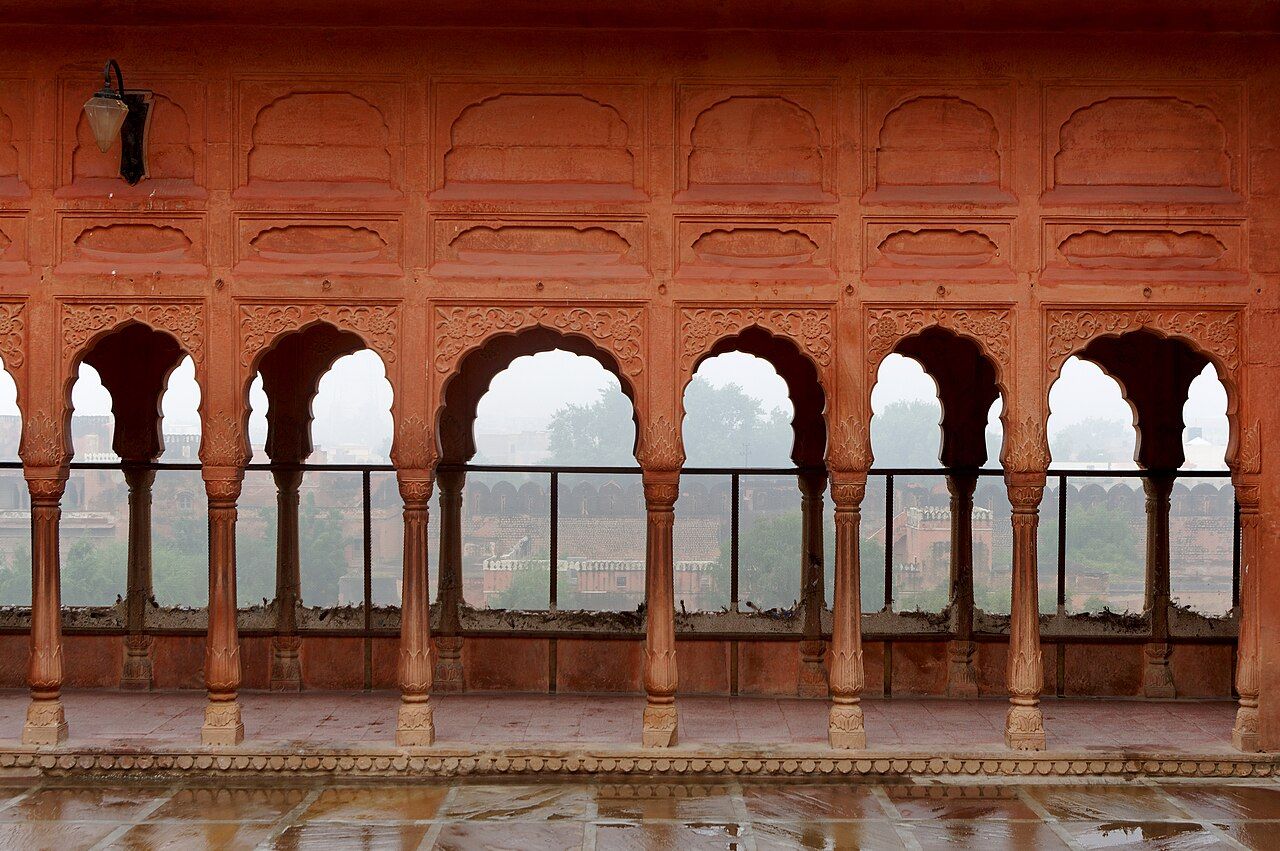
It rewards the visitor who slows down rather than the one who follows the crowd from room to room.
The old city beyond the walls
The fort is only half of Bikaner. A short ride away, inside the old walled city, are lanes lined with havelis, the grand townhouses of merchant families, built in red sandstone and carved so densely that balconies, brackets and window screens seem to cover every face. Many date from the late 19th and early 20th centuries, when Bikaner's traders grew rich across India. Walk them in the morning, when the light runs down the narrow streets and the lanes are just waking up.
Respect that these are homes as well as monuments. Many are still lived in, some are closed, and a few are in poor repair. Look from the lane unless you are invited inside. The old city also holds Jain and Hindu temples, small markets and workshops, and it is easy to spend longer there than at the fort.
Outside town, Bikaner has a long association with the camel, and there is a government camel-breeding and research centre on the edge of the city where visitors can usually see the herds. About 30 km south is the temple at Deshnoke, famous for the rats it protects, which most people combine with Bikaner in a day.
Shaping a morning inside the walls
Bikaner is about 250 km from Jodhpur, a drive of roughly five hours across flat, open desert country on a long straight road. It is also within reach of the painted towns of Shekhawati, such as Mandawa, to the east. Trains link the city with Jodhpur, Jaipur and Delhi.
- Go in the morning, both for the light and because the courtyards are hot by noon outside winter.
- Allow two to three hours for the fort museum, more if you like to linger.
- A small fee applies.
- Wear shoes you can climb stairs in; some passages are steep and narrow.
October to March is the comfortable season. From April to June the desert heat is severe, and even in the cooler months the midday sun is strong. Give the fort a morning, the old city an afternoon, and if you are moving on by car, our notes on getting around by road cover the long desert stretches.
Next in Desert towns: Deshnoke and the temple of the rats