
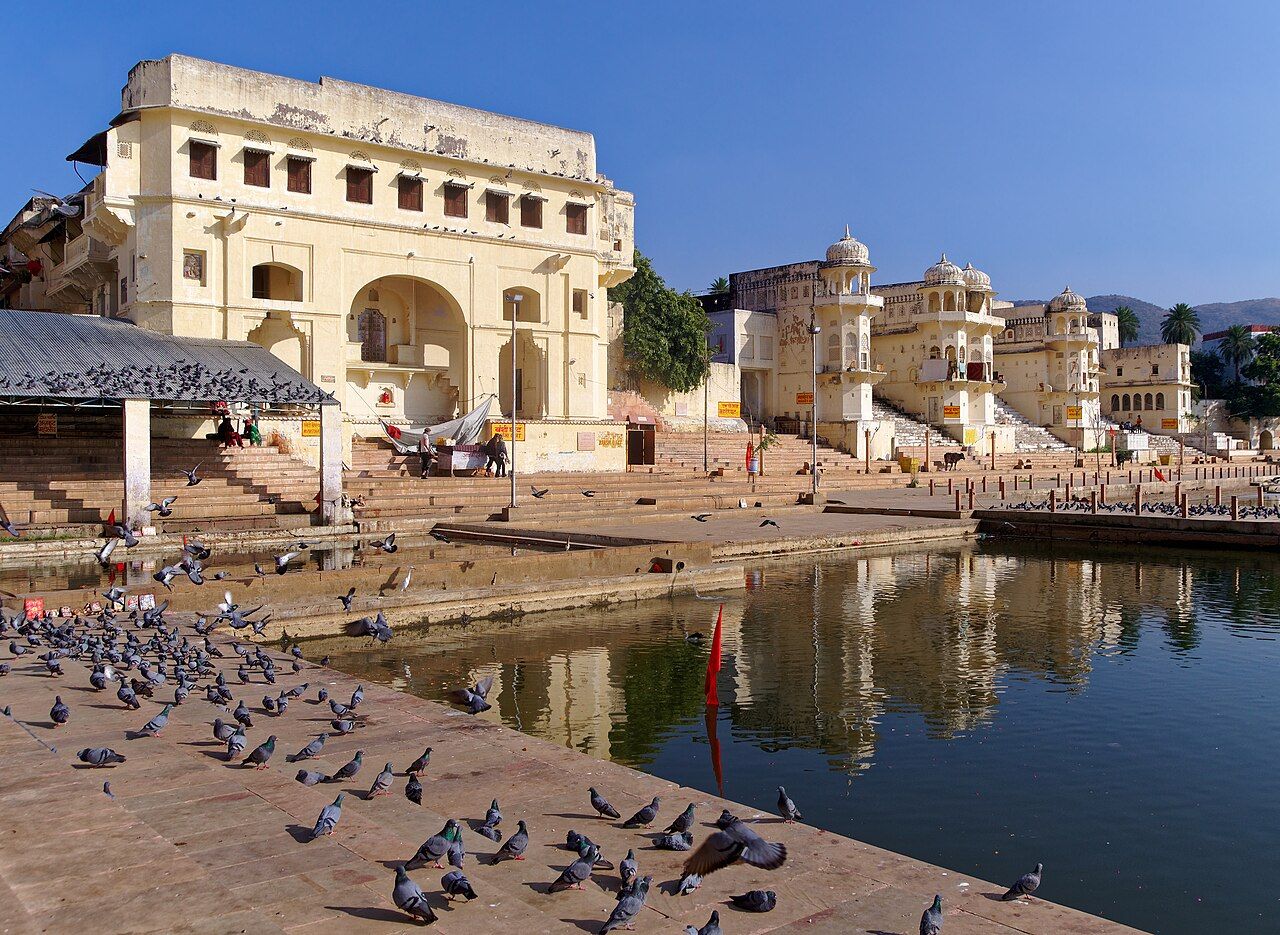
Road noteAbout 15 km from Ajmer over the Nag Pahar hills, a short winding drive. Cars stop at the edge of the old town; walk in. Shoes off on the ghats.
Pushkar sits in a bowl of low, bare hills, and you come to it over the Nag Pahar, the snake mountain, on a winding road from Ajmer about fifteen kilometres away. One minute you are among the trucks and traffic of a busy city; the next you are dropping down towards a whitewashed town and a lake that catches the sky. It is one of the holiest places in India for Hindus, and for all the backpackers and souvenir stalls along its main lane, it still feels like a pilgrimage town first.
The lake at the centre
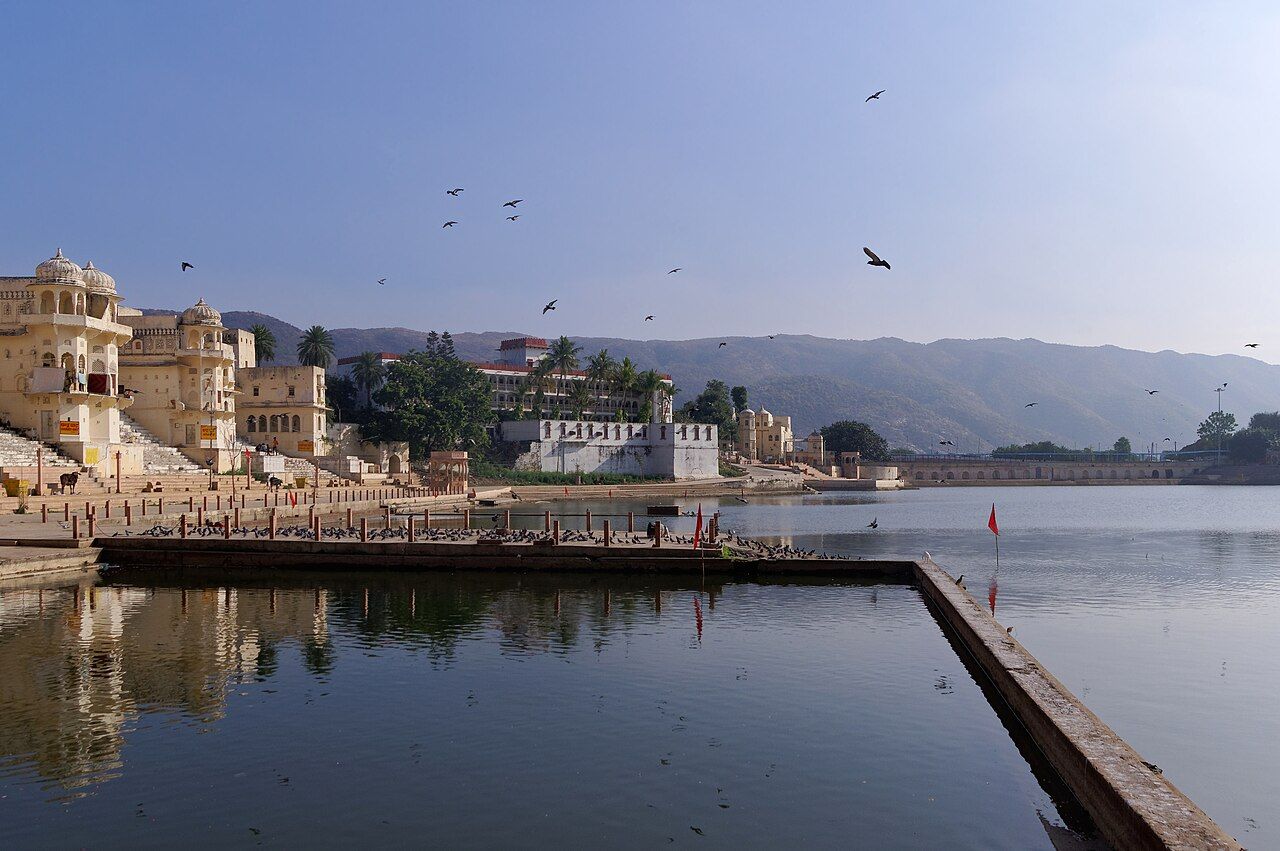
Everything in Pushkar turns towards the lake. It is small enough to walk around in an hour or so, ringed by bathing ghats, temples, old rest houses built by princely families, and the backs of tall, pale houses. Tradition holds that the lake appeared where a lotus fell from the hand of Brahma, and a dip in its water, especially during the month of Kartik, is believed to wash away sins. The number of ghats is usually given as fifty-two, though people count them differently, and some run into one another so that the line between them is hard to see.
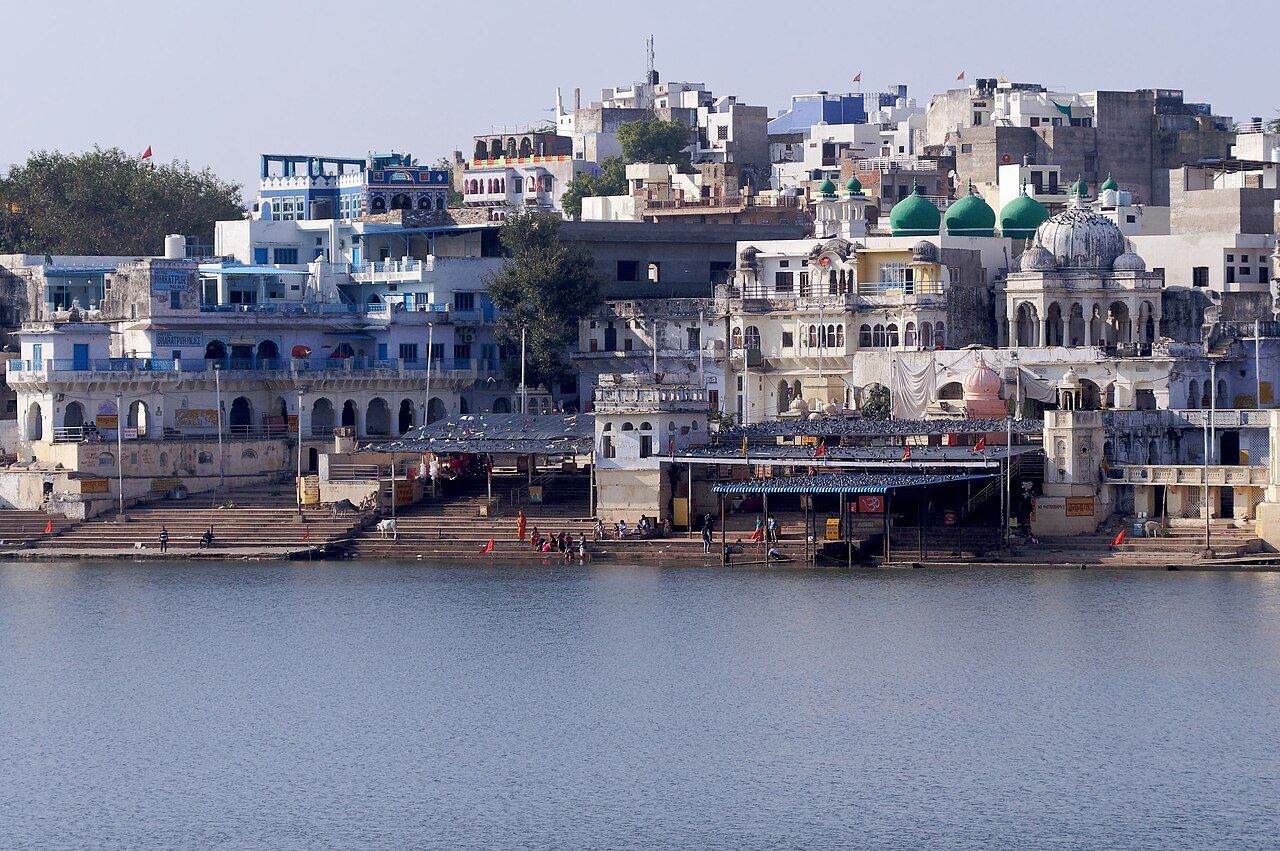
The water level changes with the rains. After a good monsoon the lake fills and laps against the lower steps; after a weak one it can shrink back, leaving a stretch of exposed stone. Either way, the shape of the place stays the same: steps leading down, shrines set back above them, pigeons everywhere, and a steady murmur of bells and chanting that rises at dawn and again at dusk.
Some ghats are better known than others. Varaha Ghat, Brahma Ghat and Gau Ghat are among the busiest, and each has its own shrines and stories. You do not need to know them all. It is enough to walk slowly along the shore, pausing wherever the steps are quiet, and to watch how the town uses its lake: for bathing, for prayer, for washing clothes, for sitting and talking as the light goes.
Barefoot on the ghats
The ghats are sacred ground, and shoes come off before you step on to them. Many have painted signs saying so, and people will remind you if you forget. Wear sandals you can slip on and off easily, and carry a small bag for them if you plan to walk the shore. Dress modestly, with shoulders and knees covered, and keep public affection out of sight; this is a place of worship, not a beach.
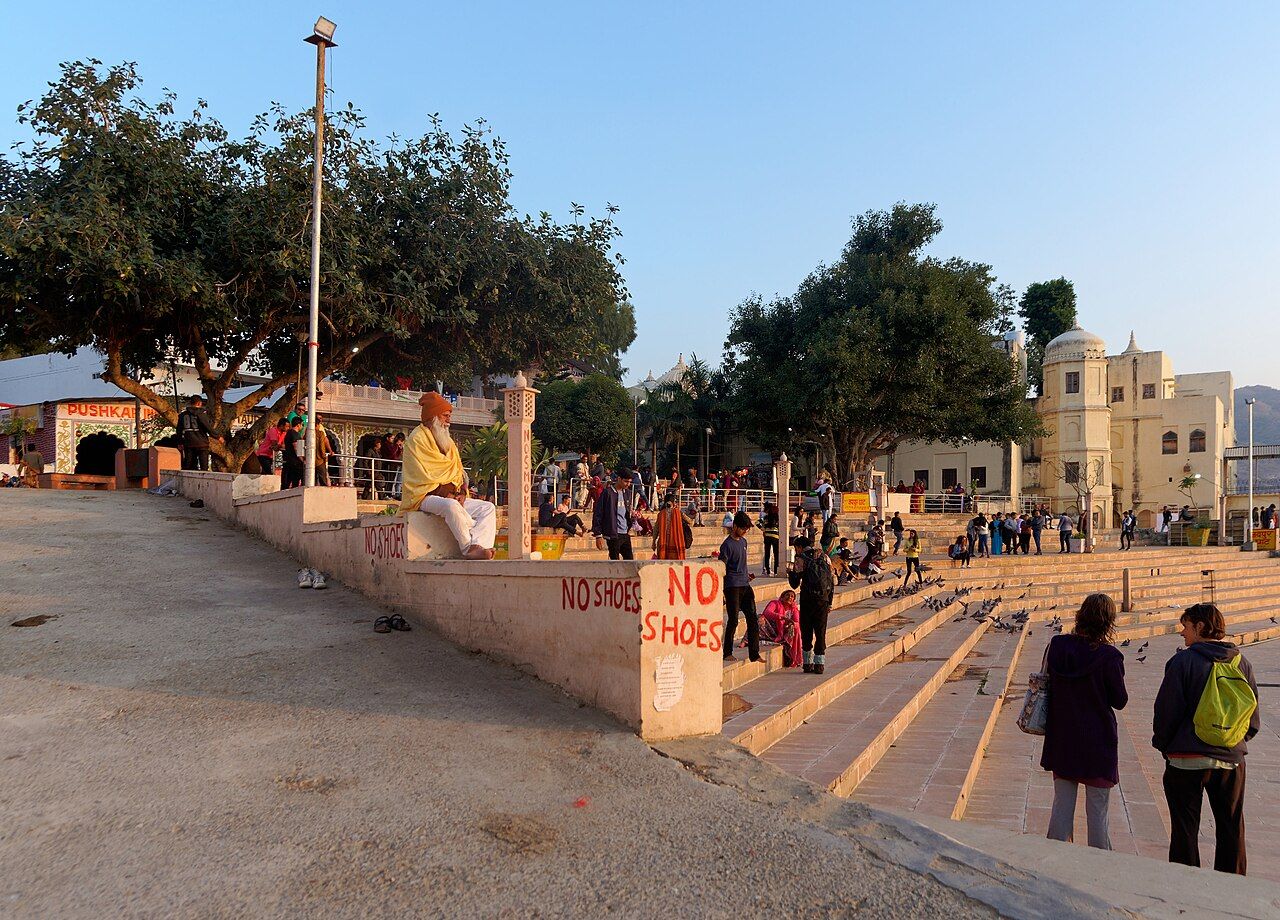
Photography is where visitors most often give offence. People come to the lake to bathe and to pray, and many do not want to be photographed while they do it. Ask before you point a camera at anyone, and if the answer is no, or simply unclear, put the camera away. Photographing the lake, the buildings and the light is a different matter, and the views from the quieter ghats are lovely enough without strangers in the frame.
Ask before you point a camera at anyone, and if the answer is no, or simply unclear, put the camera away.
You may also be approached on the steps by someone offering flowers to throw into the lake, a blessing, or a red thread for your wrist, and then asked for a sum of money, sometimes framed as a donation for your family. This is a well-known pattern in Pushkar. If you do not want to take part, a polite, firm refusal before accepting anything is the simplest course. If you do wish to make an offering, temples have their own proper places for it.
Brahma and the hill temples
The town has a great many temples, but one draws people above all. The Brahma temple, a short walk from the lake, is one of very few in India dedicated to Brahma, the creator in the Hindu trinity. Its red spire and the marble steps leading up to the entrance are easy to find; follow the flow of pilgrims. Inside, the image of the four-faced god sits in the sanctum, and the floor and walls carry small silver coins and plaques left by devotees. Shoes stay outside, cameras are often not allowed inside, and leather items may be restricted.
The story most people hear is of Brahma performing a great sacrifice at Pushkar while his wife Savitri was late, and taking another bride in her place. Savitri, angered, is said to have cursed him so that he would be worshipped in very few places. Her own temple stands on a hill above the town, and the climb up a long stepped path is worth it for the view over the lake, the rooftops and the desert beyond. Go early or late, when the stone is cool. A cable car also runs up the hill for those who would rather not climb.
On the opposite side of the valley another hill temple, dedicated to Gayatri, gives a different angle on the town. Both are good places to watch the sun rise or set, and both make clear how small Pushkar really is, set in its ring of hills.
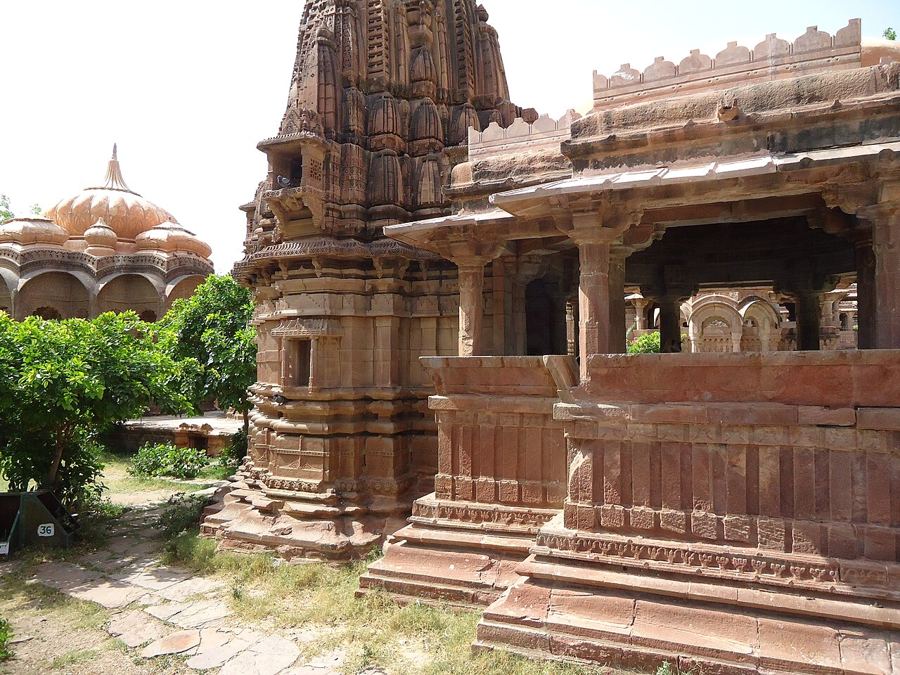 Worth the detour · MandoreMandore's red sandstone cenotaphs
A town without meat or alcohol
By long custom Pushkar is a vegetarian town, and alcohol is not part of its public life. Meat and eggs are not sold within the town, and visitors are expected to respect this. In practice it is easy: the food is good, the sweets are plentiful, and the lanes around the lake are full of places selling snacks, fresh juice and tea. Treat the custom as part of the town's character rather than an inconvenience, and do not bring either in.
The main bazaar runs close to the lake and is busy with cloth, silver, music and religious goods. It is lively and occasionally pushy, and it is easy to lose half a day there. If you want the quieter Pushkar, step off into the side lanes, where houses painted blue and white lean in close and cows wander about their business.
The camel fair in Kartik
For a few days each year Pushkar becomes something else entirely. Around the full moon of the Hindu month of Kartik, which falls in October or November, the town hosts its great camel and livestock fair alongside the religious festival. Herders bring camels, horses and cattle from across the region to the sandy ground west of town, and pilgrims arrive in huge numbers to bathe in the lake on the most auspicious days.
It is one of the great sights of Rajasthan, and also one of the most crowded. Rooms are scarce and expensive, the roads are slow, and the ghats are packed. The trading side of the fair usually happens in the days before the full moon, and the religious bathing peaks at the full moon itself. If you want both, come a few days early and plan carefully, with everything arranged well in advance. If you want the lake and the temples in peace, come at any other time in the cool season.
When and how to come
The comfortable months run from about October to March. Mornings in December and January can be cold, especially on the ghats before the sun reaches them, so bring a layer. From April to June the heat is fierce and the town slows down; in the monsoon months the lake fills and the hills turn briefly green.
Ajmer has the nearest railway station of any size, and buses and taxis run over the hill to Pushkar through the day. Our page on getting around Rajasthan by car, bus and train covers the options. Pushkar makes a natural stop between Jaipur and Jodhpur, and from Jodhpur you can carry on to the old capital at Mandore and the desert temples of Osian. Give the town at least one night. The lake at dawn, before the day's visitors arrive, is the reason to stay.
Next in Desert towns: Osian's desert temples