
Road noteAbout half an hour by car from Fatehpur on a narrow road through sandy farmland. Park on the edge of the old town and walk; lanes are tight, dusty and hot by noon.
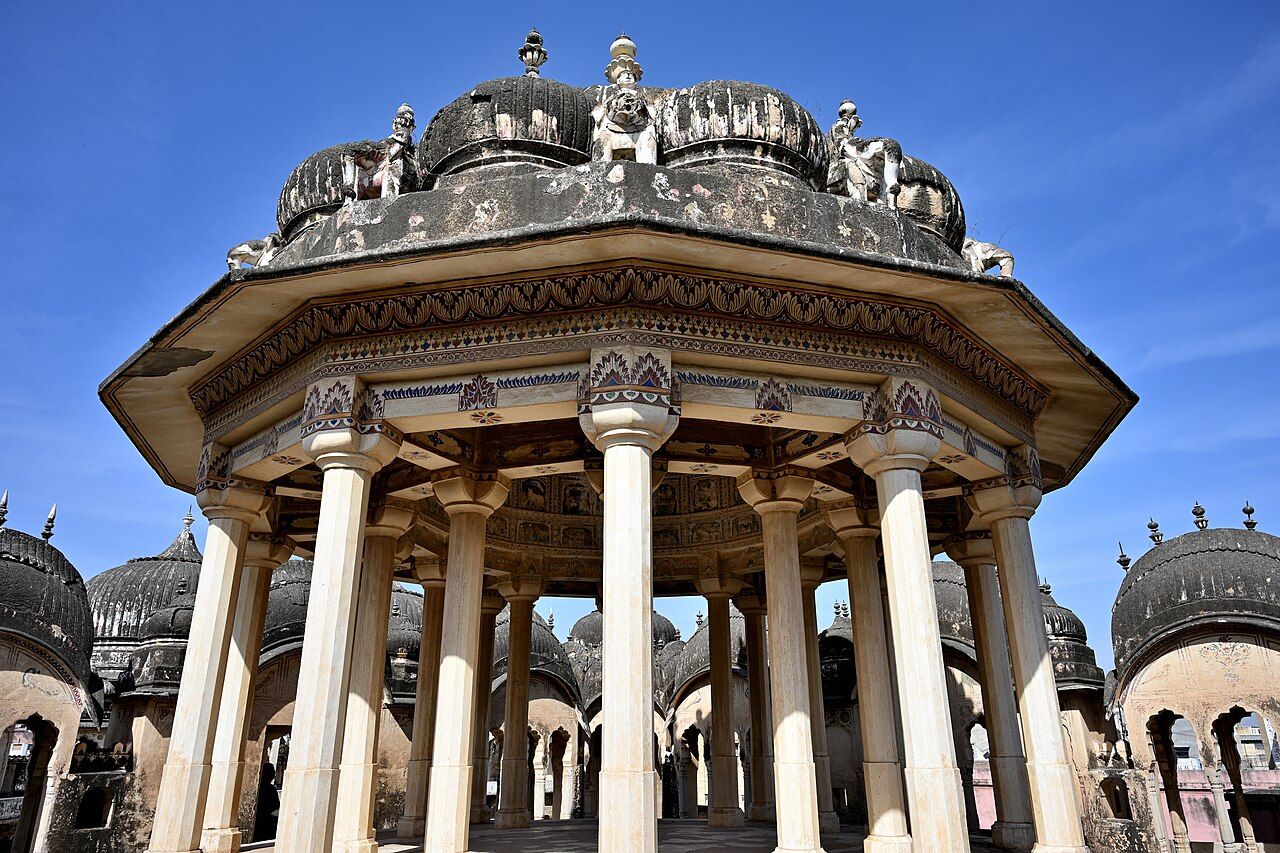
Ramgarh sits at the northern rim of Shekhawati, where the fields grow thinner and the sand shows through between the khejri trees. You reach it on a narrow road with little traffic, and the first sign of the town is not a gate or a fort but a cluster of domes standing a little apart from the houses. These are chhatris, memorial pavilions raised by the merchant families who built the place, and they are the reason most people come.
The town is often called Ramgarh Shekhawati to keep it apart from the many other Ramgarhs in India. It is smaller and quieter than the better-known painted towns to the south, and a good deal more worn. That is part of its pull. Here you see the frescoes as they are, without much in the way of restoration, and with time to look at them properly.
A town built by one merchant family
Ramgarh was founded in the 18th century by the Poddars, a Marwari trading family, and grew rich in the same way as the rest of the region: first through the caravan trade that crossed this semi-desert, then through business in the great port cities of British India. Money earned far away came home as buildings. The Poddars and the families around them paid for havelis, temples, wells and memorials, and they paid painters to cover them.
The result is a town with an unusual density of decorated buildings for its size. Many of the families left long ago, and their houses now stand locked, watched over by a caretaker or by no one at all. The streets feel half-occupied, with ordinary life carrying on in the newer parts and the old merchant quarter growing quieter every decade.
The chhatris and their ceilings
A chhatri is a domed pavilion on pillars, built in memory of a person, usually over or near the place of cremation. In much of Rajasthan they belong to royal families. In Shekhawati, the merchants built their own, and in Ramgarh they built them on a generous scale. The group of Poddar chhatris on the edge of town is the main sight: large octagonal pavilions on slender columns, with smaller domes clustered around them and stone elephants and figures on the roofs.
From outside the domes are dark and weathered. The surprise comes when you step underneath and look up. The ceilings are painted in rings, with a great flower at the centre and bands of figures circling it. Read the bands slowly and stories appear: armies on the march, chariots and elephants, monkeys in battle, gods and their companions. Scenes from the lives of Rama and Krishna fill much of the space, painted in deep reds, blues and a green that has held its colour surprisingly well under the shade of the dome.
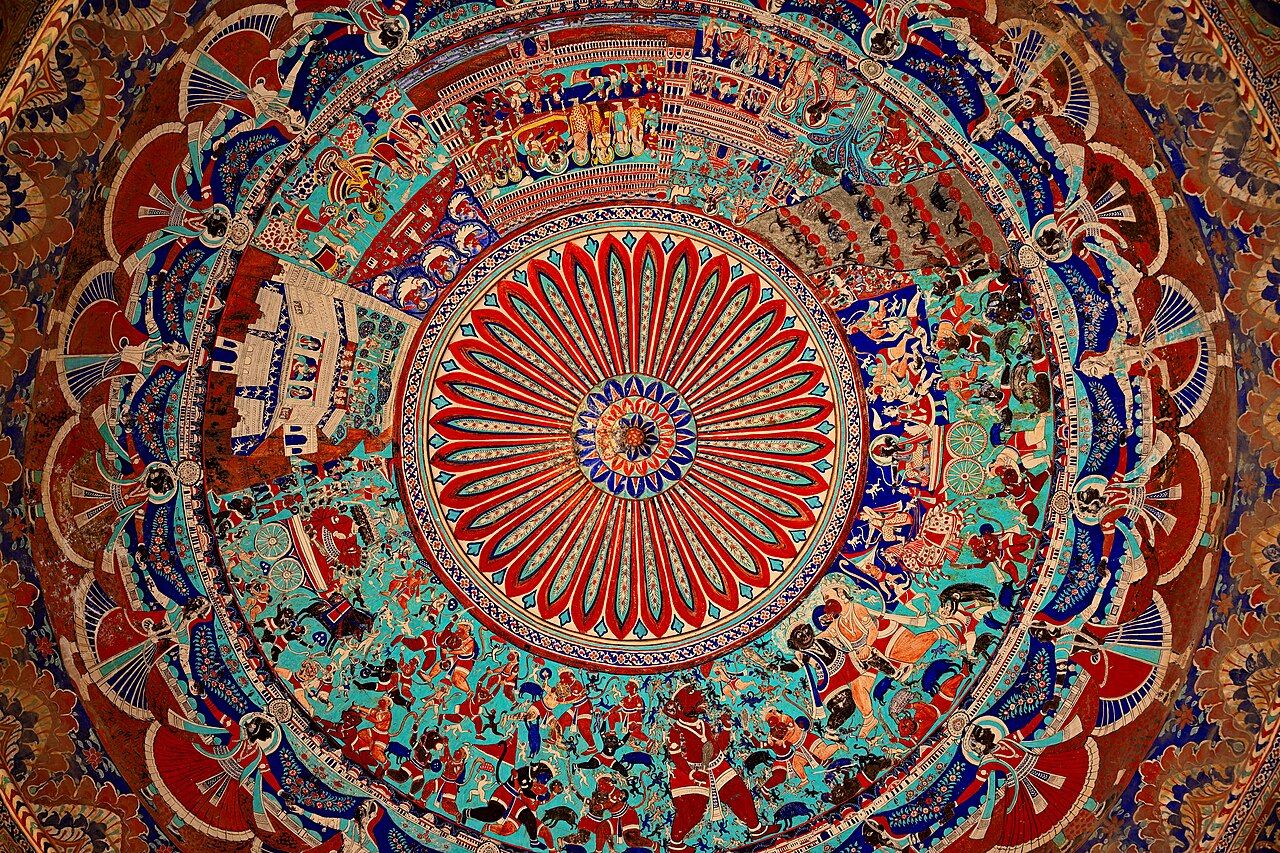
Take your time under each dome. Lie back on a step if the floor is clean and nobody minds, or simply turn slowly in place. The painters worked the scenes so that you have to move to follow them, and details hidden at one angle come clear at another. A pair of binoculars helps with the upper rings.
Temples, mirrors and the old bazaar
Ramgarh has a large number of temples for a small town, many of them built by the same families that built the havelis. The best known among visitors is the Shani temple, dedicated to the deity of the planet Saturn, whose interior is decorated with mirror work that catches the light from lamps and doorways. It is a working temple, so take off your shoes at the entrance, keep shoulders and knees covered, and ask before taking any photographs inside.
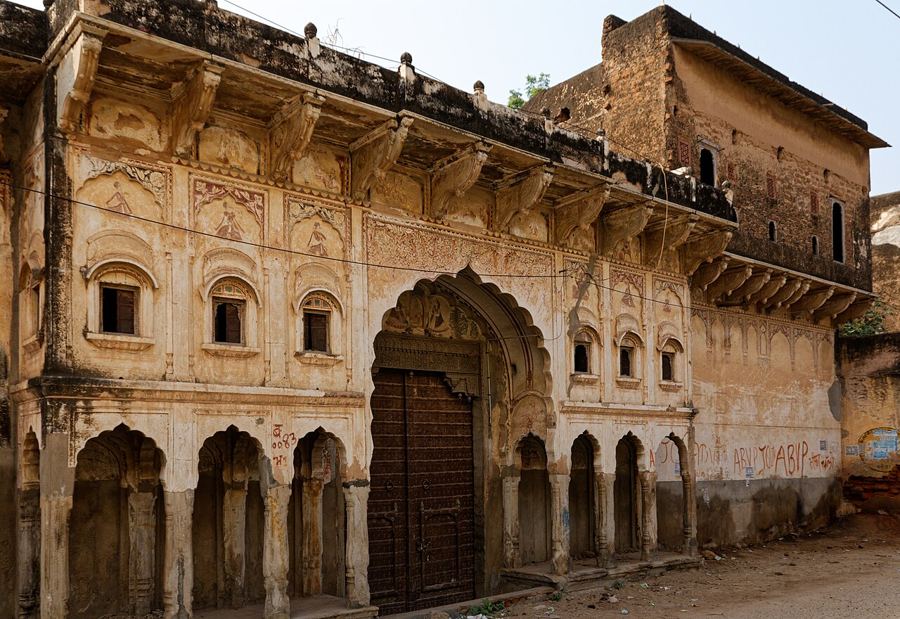
Between the temples the old bazaar runs in narrow lanes lined with havelis. Look for painted panels above doorways and along the upper storeys: processions, gods, horsemen, flowers in repeating borders. Some walls are almost clean of paint, others still crowded with figures. Doors are often carved and studded with iron, and many are padlocked.
 Worth the detour · FatehpurFatehpur and the step-well of Shekhawati
Reading the decay
Ramgarh is more decayed than most of its neighbours, and you should come prepared for that. Plaster has fallen from whole walls. Rain, salt and neglect have bleached some panels to ghosts. Roofs have gone on a few houses, and the occasional balcony hangs at an angle that makes you step to the other side of the lane.
It can be sad to see, and it is also instructive. Where the top layer has gone, you can sometimes see how a wall was built and painted: the lime ground, the outlines, the layers of colour. Frescoes in this region were first painted on wet lime plaster, which binds the pigment into the wall, and later more often on dry plaster, which is quicker to work but less durable. The difference shows in what survives.
Do not climb on crumbling walls or pull at loose fragments, however tempting it is to see what lies beneath. And do not treat an empty-looking house as abandoned: many still belong to families who live elsewhere and may return for weddings and festivals.
Walking it with care
The old town is easy to cover on foot in a morning. Start at the chhatris while the light is soft, then walk into the bazaar and let the lanes lead you. There is no fixed route and no need for one. If a door stands open and someone is sitting nearby, a caretaker may offer to show you a courtyard for a small fee. Always ask before you step inside a courtyard, even one that seems public, and accept a no with good grace.
People live here, and the lanes are their front rooms. Ask before photographing anyone, keep your voice down near temples, and give way to cattle, motorbikes and handcarts, all of which have priority in practice. Carry water and a hat, because shade is patchy and the town warms quickly after ten in the morning for much of the year.
The comfortable season runs roughly from October to March. December and January mornings can be cold and hazy, which suits walking but softens the colours; late afternoon light in November and February is the kindest to the frescoes. From April to June the heat makes a long walk hard work, and the monsoon months from July to September bring the occasional downpour and slippery lanes.
Fitting Ramgarh into a Shekhawati circuit
Most people combine Ramgarh with other painted towns rather than coming for it alone. It sits about 20 km north of Fatehpur, and from there the roads lead on to Mandawa and down to Nawalgarh, each with a different mix of restored and unrestored havelis. Two or three nights in the region let you see several towns without rushing, and the distances are short enough that the driving never takes over the day.
If you are planning the wider loop, our notes on getting around Rajasthan by road cover hiring a car and driver, realistic driving times and the rhythm of rest days. Ramgarh rewards a slow morning more than a quick stop, so give it the first hours of a day rather than a tired half-hour at the end of one.
Next in Shekhawati: Fatehpur and the step-well of Shekhawati