
Road noteAbout two and a half to three hours from Udaipur on winding Aravalli hill roads. Shoes stay outside, leather is not allowed, and visitor hours are restricted.
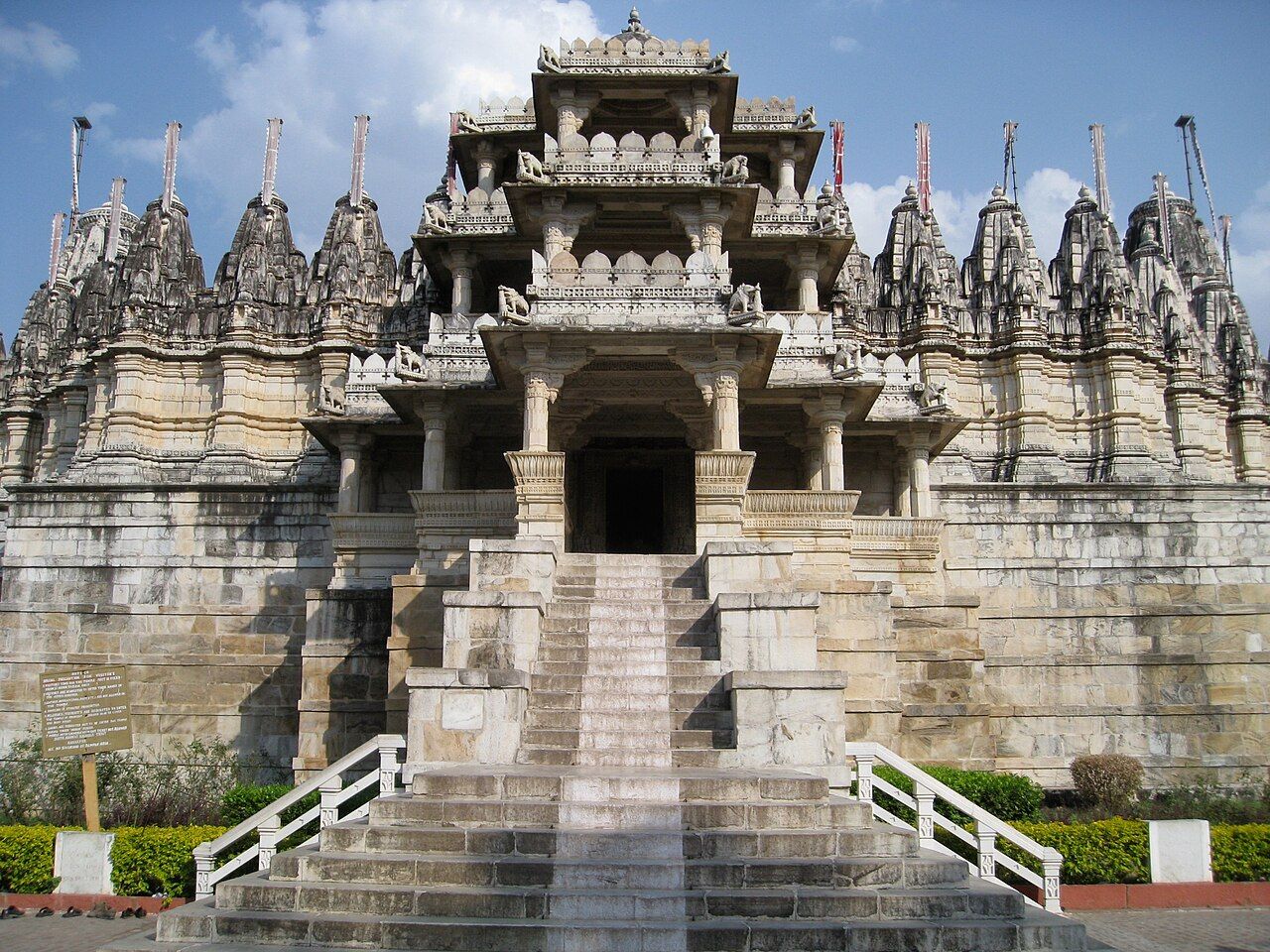
The road to Ranakpur leaves the lake country around Udaipur and climbs into the Aravallis, low worn hills covered in scrub and dry forest. Villages thin out, the bends tighten, and then the valley opens just enough to hold a temple that looks, from the car park, far too large for the place. Pale stone walls rise in tiers, crowned by a cluster of spires and small domes, with flags lifting off the tops. Up close the scale keeps growing: the steps alone are a climb.
This is the main Jain temple of Ranakpur, the Chaturmukha temple, dedicated to Adinath, also called Rishabhanatha, the first of the Jain tirthankaras. It is a working place of worship, not a monument, and the whole visit goes better if you hold that in mind from the start.
A temple built on a merchant's devotion
Construction began in 1437, in the 15th century, when a Jain merchant named Dharna Shah set out to build a temple worthy of Adinath, with the support of Rana Kumbha, the ruler of Mewar who also raised the great walls at Kumbhalgarh a short way north. The village and the temple take their name from the ruler. Building went on for decades, and later generations added to it, but the core design held: a temple that faces all four directions at once.
That is what Chaturmukha means, roughly "four-faced". The central shrine holds images of Adinath looking out to each point of the compass, and the building is laid out so that you can approach from any side. In plan it is close to a square, with halls, porches and smaller shrines arranged around the centre so that every path leads you back inward. It is a building that rewards a slow circuit more than a straight line.
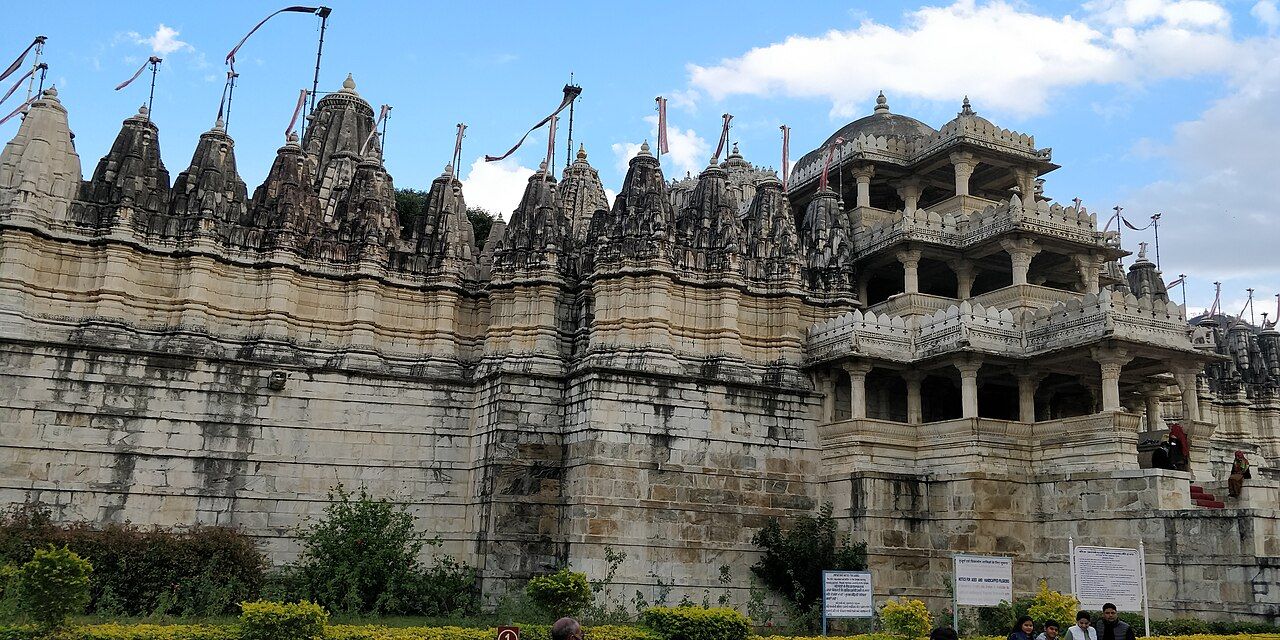
The setting matters too. The valley is green after the monsoon and dusty gold by late spring, and the hills on every side keep out most of the noise of the wider world. Monkeys work the trees around the compound. On a weekday in the cooler months, with only a scatter of visitors, it can be very still.
The pillars, and why nobody agrees on the count
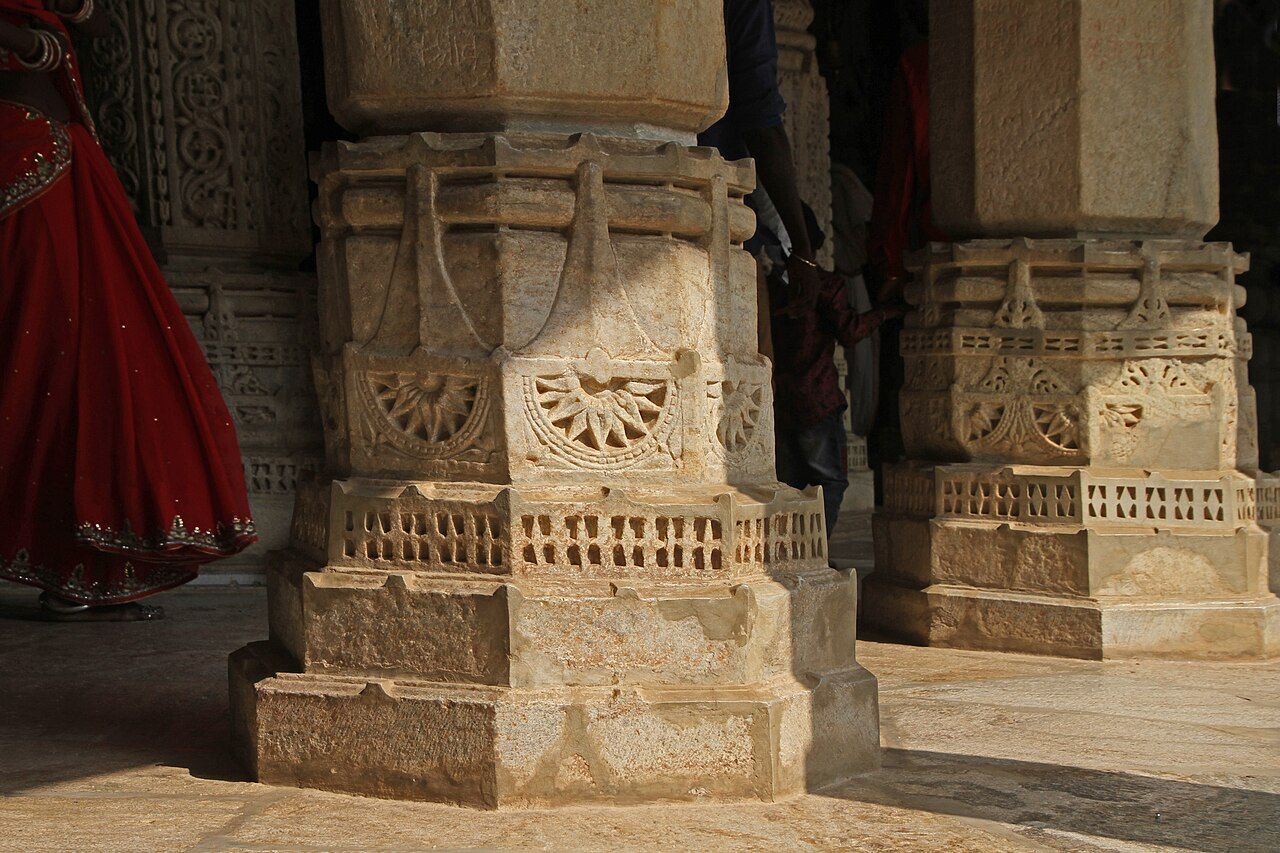
Inside, the temple is a forest. Marble columns rise from the floor in every direction, carrying domes and brackets and beams, and as you move the lines of sight shift so that new rows appear and old ones close. The number of pillars is often said to be 1,444, and it is often said that no two are alike. You will not count them, and you do not need to. What you notice instead is the variation: one column carved with dancers, another with bands of flowers, another with tiny seated figures stacked like shelves.

Look up as often as you look around. The domes are carved in rings that step inward towards a hanging central boss, and the brackets that hold them are cut so deeply that the marble seems to lose its weight. Then look down, because the bases of the columns are carved too, with lotus rosettes and small pierced railings that most visitors walk straight past.
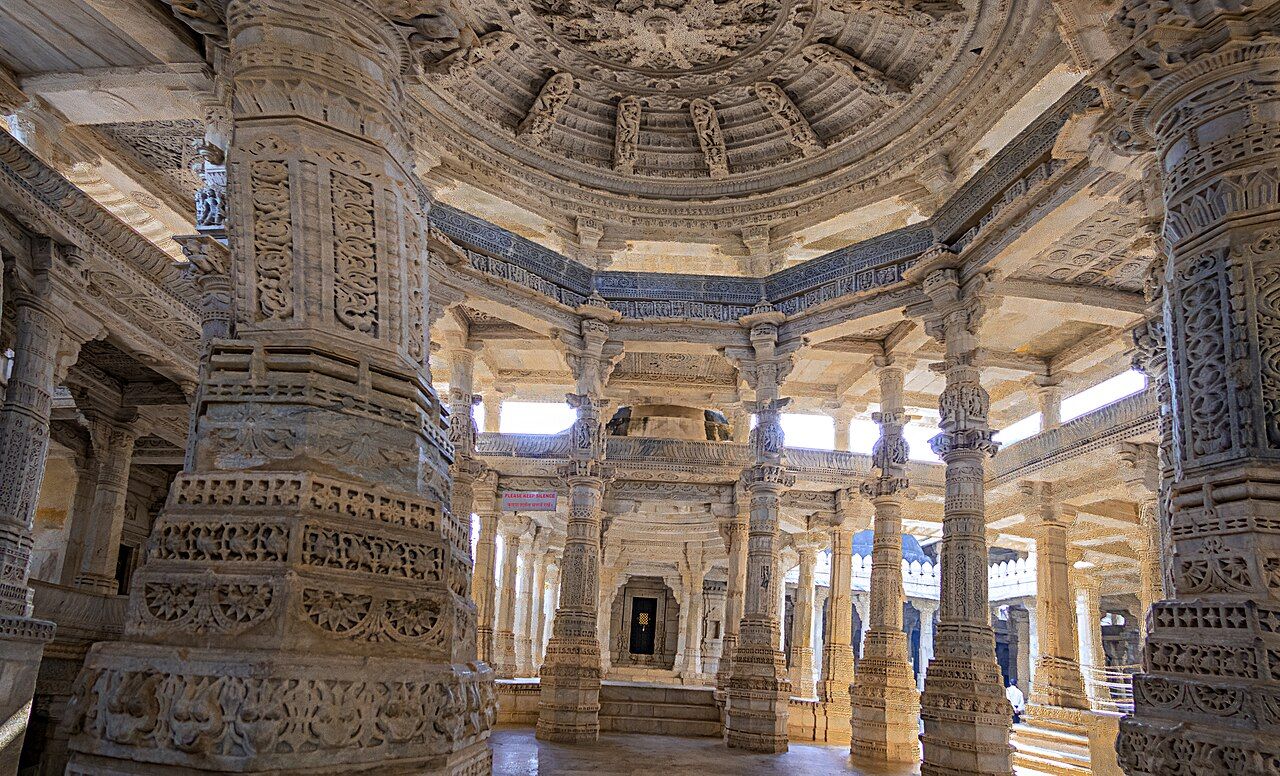
The light is the other half of the building. The halls are open to the sky in places and the marble is pale, so the sun moves through the interior all day, warming one column and leaving its neighbour grey. Around midday the shadows are short and the stone almost glows. The effect is not of a dim sanctuary but of a bright, shifting space.
You will not count them, and you do not need to.
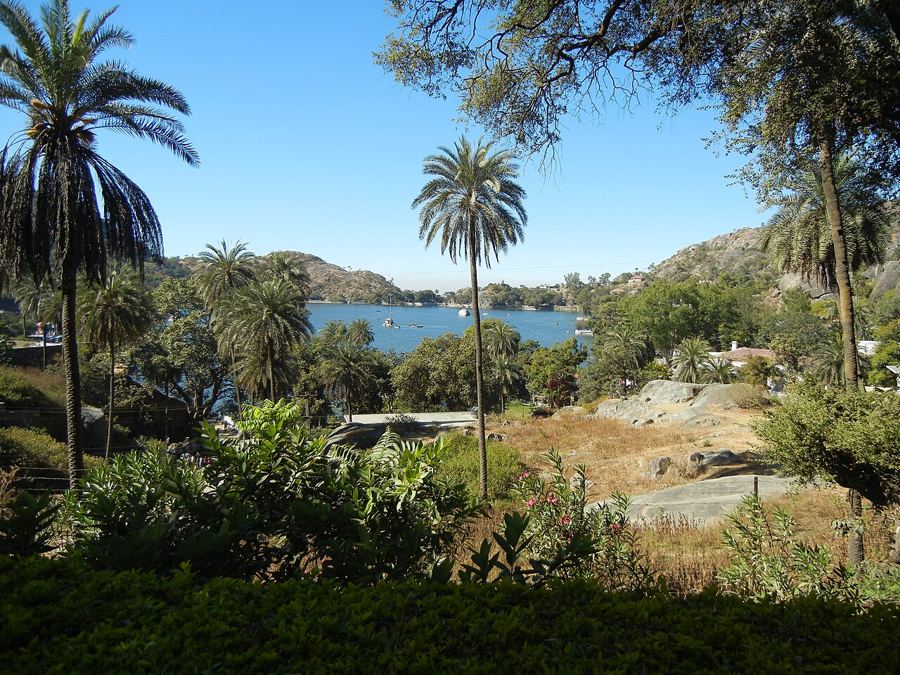 Worth the detour · Mount AbuMount Abu and the Dilwara temples
Rules for visitors
Ranakpur is a Jain temple, and the Jain tradition takes non-violence and purity seriously. That is the reason for its rules, and they are enforced at the gate. Leave anything made of leather behind: belts, wallets, bags, watch straps and of course shoes, which come off before you go in. Dress so that your shoulders and knees are covered; a light scarf or cloth wrap is useful if the day is warm. Food and drink stay outside.
Visitors who are not coming to worship are let in only during restricted hours, usually from around the middle of the day into the afternoon. Mornings are kept for worship.
- Shoes off at the entrance; the marble can be hot underfoot by afternoon.
- No leather of any kind inside the temple.
- Shoulders and knees covered, for everyone.
- As a temple rule, women who are menstruating are asked not to enter.
- Rules on cameras and phones vary, and a small fee may apply; check at the gate and do not photograph worshippers or the inner shrine.
The best preparation is simple: speak quietly, walk around shrines and worshippers rather than through them, and let people at prayer have their space.
Making the day work
Most people come from Udaipur, about 90 km to the south, which makes for a long but easy day on the road. The drive takes roughly two and a half to three hours each way, depending on traffic and how often you stop. The road is paved but winds through the hills, so leave early enough to arrive before the visiting hours begin and to have time for a slow walk round the outside first.
Many travellers pair Ranakpur with Kumbhalgarh, the hill fort whose walls snake across the ridges to the north. Doing both in one day is possible but tiring; the two places deserve better than a rush. If you can, stay a night in the area and give each its own half day. Others continue south and west towards Mount Abu, which keeps another set of carved Jain temples on its plateau. Coming back to Udaipur at dusk, you will find the lake city feels busy after the valley.
Around the main temple there are smaller shrines in the same compound and nearby, including a carved temple to the sun god. They are worth the short walk, and they are usually quieter still.
Cool months in the Ranakpur valley
October to March is the comfortable season, with warm days and cool mornings in the hills. From April to June the heat on the marble and the drive is hard work, and July to September brings the monsoon: the valley turns green and the hills look their best, but roads can be slow after heavy rain. Jain festival days bring crowds of pilgrims, which is a different and more devotional visit; if you want stillness, aim for an ordinary weekday.
Whatever the season, give the temple time. A quick loop takes half an hour. A proper visit, with time to sit on a step and watch the light move across the columns, takes much longer, and is the reason to come. If you are building a longer trip, our notes on getting around by road cover what a day with a car and driver in the hills involves.
Next in Mewar: Mount Abu and the Dilwara temples