
Road noteAbout 85 km from Jaipur, the last stretch on smaller rural roads, so allow two to three hours each way. Paths are rough and stony. Entry is daylight only; check timings.
At the foot of a steep, scrubby ridge in Alwar district, on the edge of the Sariska Tiger Reserve, a walled town lies in ruins. Its main street is still paved, lined on both sides by the stone shells of shops. Temples stand intact among the rubble, and at the top of the slope the broken walls of a palace look out over the plain. Bhangarh is a beautiful and slightly melancholy place, and for many Indian visitors it is famous for one reason above all: it is said to be haunted.
A town that emptied
Bhangarh was founded in the late sixteenth or seventeenth century, under the Kachhwaha family of Amber, the clan of Raja Man Singh, the great general of the Mughal emperor Akbar. It grew into a prosperous small town, with a market, temples, gardens and houses climbing towards the palace. Then, within a few generations, it declined and was abandoned. Why is not clearly known. War, famine and the loss of water have all been suggested, and none has been proved.
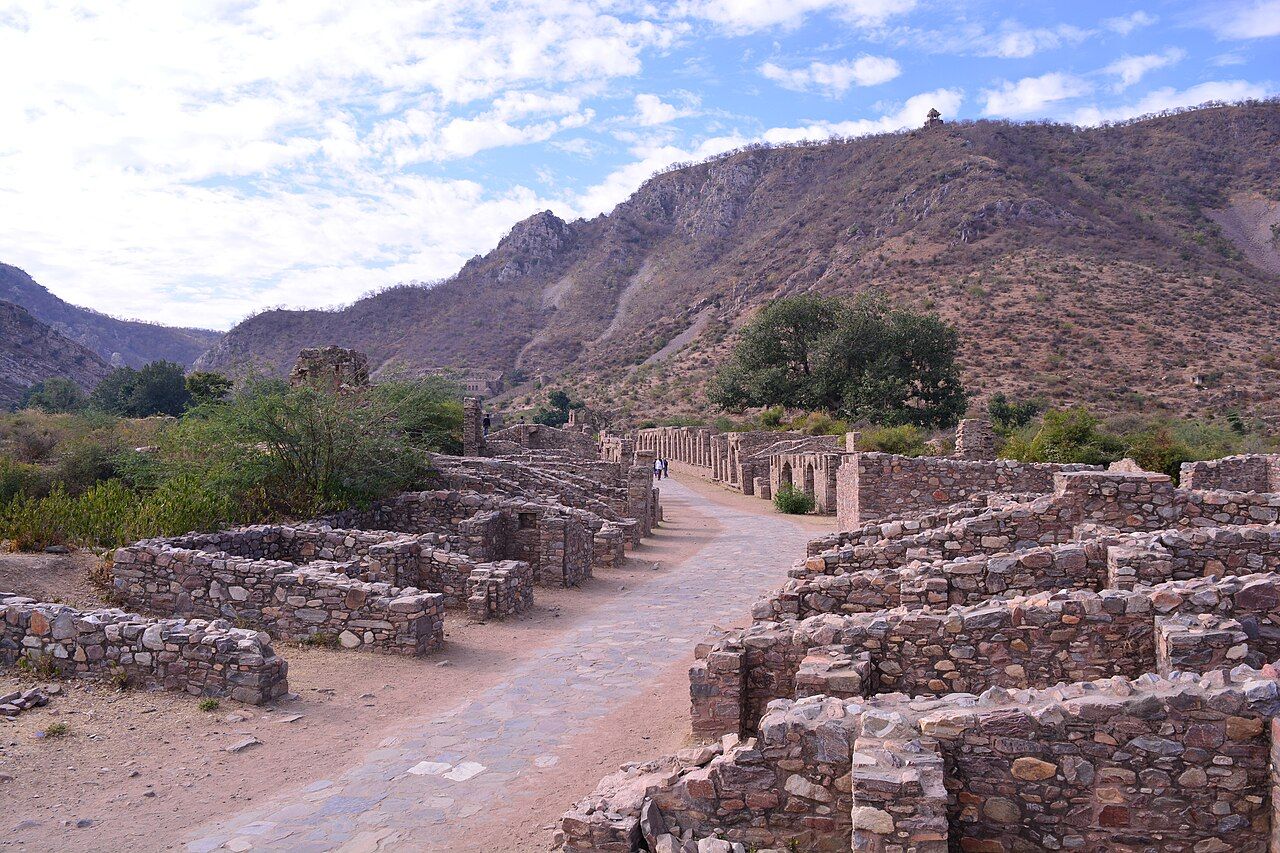
What remains is the outline of a planned town. A series of walls and gates encloses it, and the main road runs straight from the outer gate towards the palace, crossing the lower town on its way. Most of the houses are reduced to low walls, but the larger buildings, especially the temples, have survived remarkably well.
The market street
The first thing you walk along is the old market. A broad paved street runs between two long rows of small, roofless stone rooms, each one a shop opening onto the road. Arches survive here and there, and the steps and platforms where traders once sat are still in place. It takes little imagination to fill the street with carts, cloth and grain.
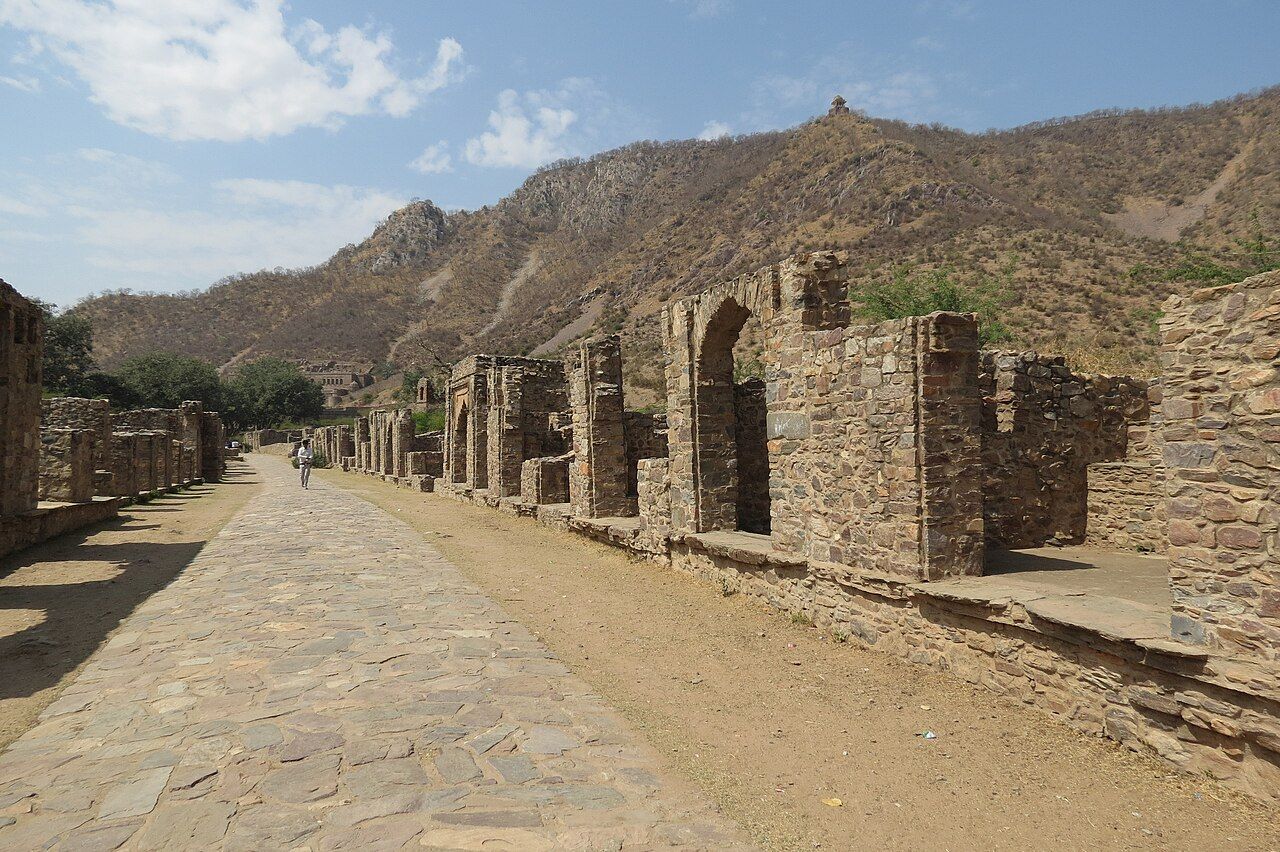
Beyond the market the ground rises, and the path passes through gardens and past larger houses. Banyan and peepal trees grow among the ruins, and langur monkeys sit on the walls. In the morning the hills behind the town catch the light first, and the whole valley is quiet.
Temples and the palace
Several temples survive within the town walls, and they are the best-preserved buildings at Bhangarh. The Gopinath temple, dedicated to Krishna, stands on a high plinth and is carved with fine detail on its spire and walls. Other temples, to Shiva and to other deities, stand nearby, some still visited by worshippers. Remove your shoes where asked and treat them as living places.
 Worth the detour · RanthamboreRanthambore: the fort as much as the tigers
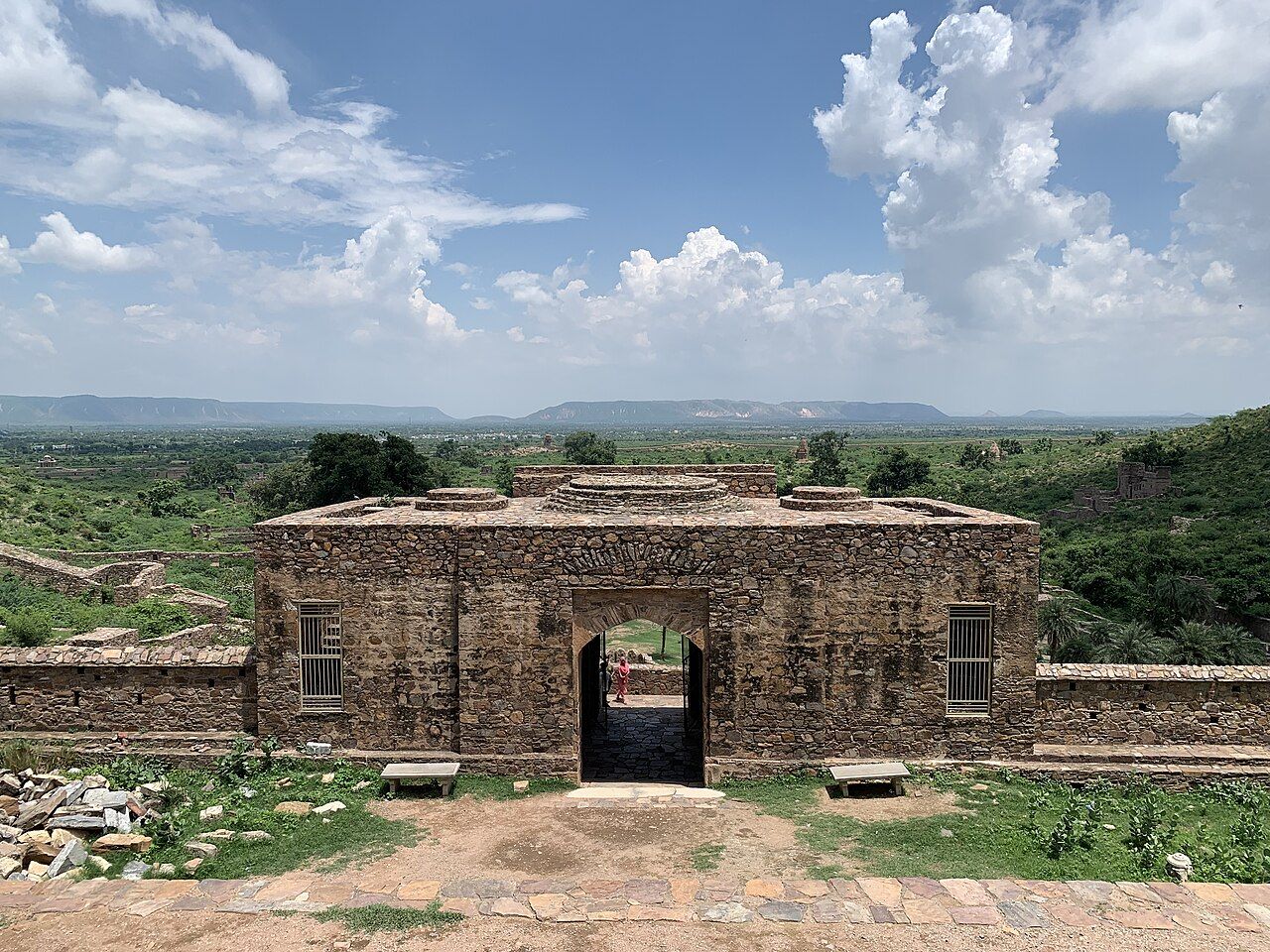
At the top of the slope stands the palace. Only parts of it survive, built of rough stone over several levels and terraces, but the climb is worth it for the view. From the upper rooms you look straight down the line of the main street to the gates, and out across a wide green plain to the far hills. Watch your footing: the stones are loose in places and some floors have gone.
The ghost story and the rule
Bhangarh's fame comes from its legends. The best known tells of a sorcerer who fell in love with a princess of the town, tried to win her with a spell, failed, and cursed the town as he died. Another tells of a holy man who allowed the town to be built on condition that no building's shadow should fall on his retreat, and of the ruin that followed when that promise was broken. Neither story can be traced to fact, and both are told in many versions.
The legend has made Bhangarh a fixture on lists of haunted places, and it draws groups of young visitors looking for a thrill. What gives the stories extra force is a real rule. The Archaeological Survey of India, which protects the site, forbids entry between sunset and sunrise, and a sign at the gate says so. The rule is about safety and protection of the monument, but in Bhangarh it is widely read as proof of something more. Either way, it is the law, and you should be out before dark.
Visiting Bhangarh
The site is open in daylight only, and a small fee is charged at the gate. Allow two to three hours to walk from the gate up to the palace and back, with time to look around the temples. There is little shade on the main street and the paths are stony, so wear sturdy shoes and carry water.
- Go early in the day, when the light is soft and the crowds are thinner.
- Weekends and holidays bring large groups; weekdays are quieter.
- Keep food in your bag; the monkeys are bold.
- Do not climb on fragile walls or carry away any stone.
The comfortable months are from about October to March. From April to June the valley is very hot, and the climb to the palace is hard work in the midday sun. In the monsoon the hills turn green, but the roads can be slow.
The road to the ruined town
Bhangarh lies about 85 km from Jaipur, and most people come for a long day, by car with a driver. The last part of the drive is on smaller roads through villages and farmland, so allow more time than the distance suggests. The site is also within reach of Alwar, and it can be combined with a drive past the edge of Sariska, whose forest and hills you see from the road.
For a slower loop of eastern Rajasthan, Bhangarh fits well with the water palaces of Deeg and the Keoladeo marsh at Bharatpur to the east. Our page on getting around Rajasthan by car, bus and train covers how to manage the distances.